
Skip to content

August 2026 / Rental property investors

The DSCR Investor’s Playbook

A rental-finance playbook that goes beyond the DSCR formula to qualifying rent, leverage, cash flow, interest-only debt, cash-out, BRRRR and portfolio growth.

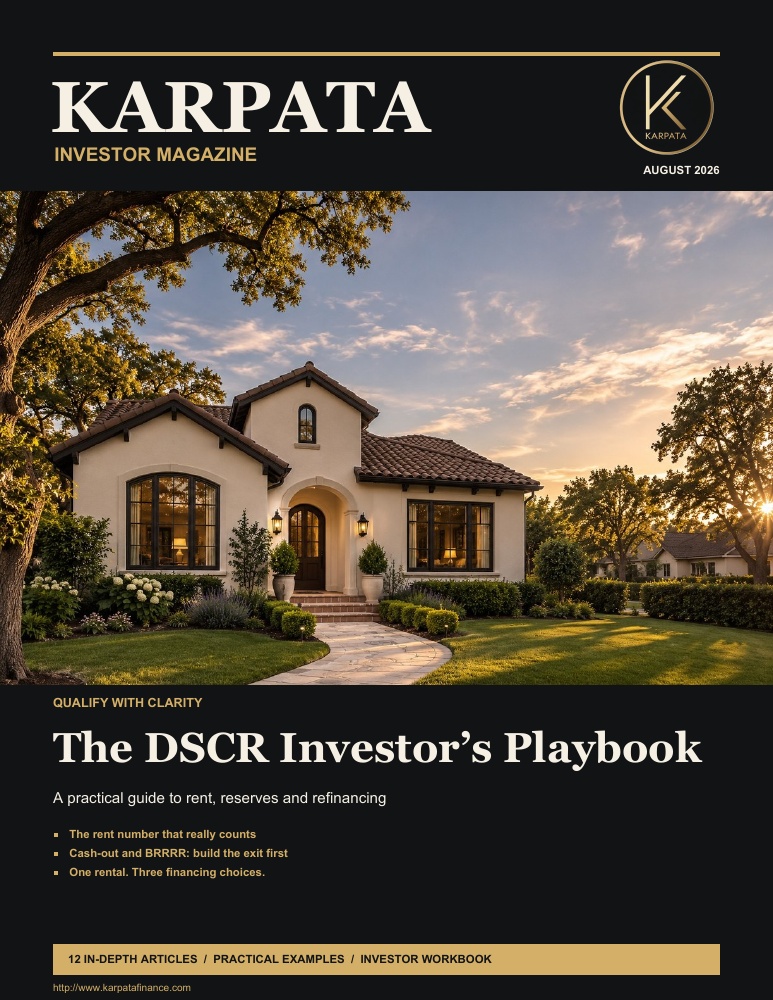
August 2026 magazine cover

FROM THE EDITORIAL DESK

Understand the ratio. Protect the cash flow. Build the portfolio.

A good rental-finance plan connects the lender worksheet with the realities of ownership. This edition follows that connection from the first DSCR calculation to cash-out, rehabilitation and portfolio growth. Use the examples to understand the mechanics, then replace the teaching assumptions with sourced facts for your own property. The objective is a loan and an operating plan that work together after closing.

12 ARTICLES / 29 PAGES / INVESTOR WORKBOOK

Inside this issue

Practical guidance, one decision at a time.

An attractive cream stucco rental house in a landscaped neighborhood at sunset.

01 / FEATURE

DSCR Loans Explained: What Lenders Actually Measure

A rental house can qualify for financing and still need a better operating plan. Understanding that distinction is the beginning of responsible DSCR investing. Debt service coverage ratio expresses a relationship between income and a required payment, but the income and payment definitions depend on the product. A ratio without those definitions is an incomplete number.

Read article 5 MIN / 1,019 WORDS


Investment planning desk with a calculator and rental houses visible through the window.

03 / FEATURE

Beyond the Ratio: Does Your Rental Actually Make Money?

The lender approves the ratio, the closing goes smoothly, and the first rent payment arrives. That is a promising start. The next question is whether the property produces enough money to support maintenance, ownership and the investor's goals. Cash flow is the result of a complete operating system, not simply the difference between rent and the mortgage payment.

Read article 5 MIN / 964 WORDS
White bungalow viewed during an investment-property visit.

04 / FEATURE

Choosing Leverage: Down Payment Versus Liquidity

The down payment is not simply a hurdle to overcome. It is part of a capital allocation decision between equity in the building and cash available to operate the investment. More leverage can preserve funds at closing, while a smaller loan can reduce the payment and improve flexibility. The better choice depends on the property and the investor's entire cash position.

Read article 5 MIN / 975 WORDS
Neighboring townhomes illustrating a comparison of financing structures.

05 / PRACTICAL GUIDE

Interest-Only or Amortizing: Compare the Full Trade-Off

Interest-only financing reduces the scheduled payment during a defined period because the borrower is not paying down principal through that payment. Amortizing debt combines interest and principal so the balance generally declines over the amortization schedule. Each structure can serve an investment purpose, but they create different cash-flow and exit obligations.

Read article 5 MIN / 948 WORDS

READ AT YOUR PACE

The complete August 2026 edition.

Save all 12 illustrated articles and the investor workbook.

Download PDF magazine